Tips
Choosing the right sliding door for your home
Step one: Envisioning your perfect patio door
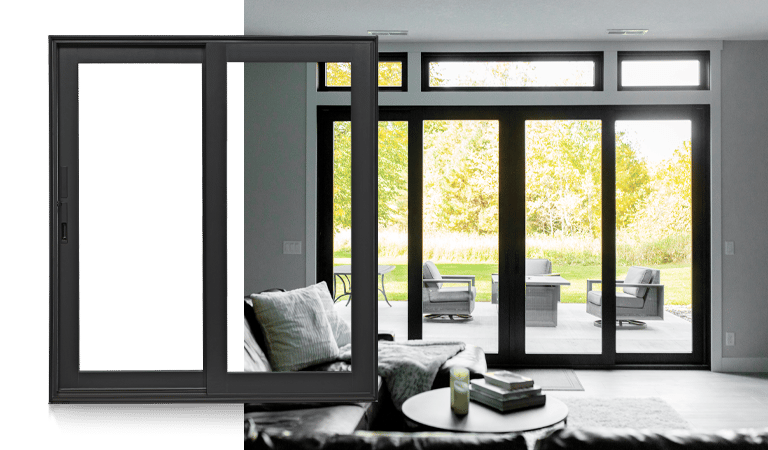
Door typeGliding patio doors are what we call our sliding glass doors. They slide parallel with the wall and are typically two panels, though they don’t have to be. | ProsWe offer a wide array of materials, styles, and performance options (PG upgrades) since gliding patio doors are available through all our series. | ConsA gliding patio door will always include one panel that’s fixed (doesn’t move). | Where to find this productWe offer gliding patio doors through all of our product lines (100 Series, 200 Series, 400 Series, A-Series, E-Series, and our Andersen Aluminum). | What else to knowTwo-, three-, and four-panel configurations are available. Triple-pane glass is available with many of our gliding patio doors. |
Door typeThe Multi-Slide Door is our completely aluminum, large-scale sliding patio door. | ProsThe Multi-Slide Door can be up to 12 feet high and 44 feet wide. Its aluminum finish gives it a beautiful high-end look but it’s still priced to offer exceptional value. | ConsThis is a completely aluminum product, which means it’s best suited for desert and other warm weather locales. A thermally improved option is available to maximize energy efficiency. | Where to find this productThe Multi-Slide Door is offered through our Andersen Aluminum product line. | What else to knowThe Multi-Slide Door can wrap around a corner, pocket, open from the center, and more — a variety of configurations are available. |
Door typeThe MultiGlide™ Door is a large-scale sliding patio door that comes with a variety of luxurious options. | ProsThe MultiGlide Door can be up to 10 feet tall and 50 feet wide. A variety of material and style options are available. | ConsThis is a premium product, so it’s not the best option for a tight budget. | Where to find this productThe MultiGlide Door is offered through our Big Doors product line of oversize patio doors. | What else to knowThe MultiGlide Door can disappear into the wall (called pocketing), open automatically, open from the center, and more — a variety of configurations are available. Triple-pane glass is available with our MultiGlide Door. |
Door typeThe Liftslide Door is our premier sliding door and the largest of what we call our moving glass wall systems. It’s precision engineered for nearly effortless operation, even at massive scale. | ProsThe Liftslide Door is the go-to for the largest size (up to 16 feet tall by 60 feet wide), highest performance, most material options, and of course, a variety of style options. | ConsThis is a premium product with a price to match. | Where to find this productThe Liftslide Door is offered through our Big Doors series of oversize patio doors. | What else to knowThe Liftslide Door can curve! It can be styled to look like a barn door, wrap around corners, pocket, open from the center, and more — the configurations we offer let you dream big! Triple-pane glass is available with our Liftslide Door. |
Build with confidence
Your guide to building a new home
Choosing the right material for your sliding glass door
Materials affect the look, feel, and performance of your sliding door. They also determine the kind of maintenance you’ll be signing up for long term (though our doors are largely made of low-maintenance materials). Here’s a cheat sheet to the way we use materials:
Wood
Wood is at the core of most of our gliding patio doors, our MultiGlide Door, and our Liftslide Door, providing beauty on the interior, strength, and thermal performance. However, wood can be vulnerable to the elements and require more maintenance. For this reason, most of our wood sliding doors are clad in a protective exterior material such as vinyl, aluminum, or composite. These materials add durability where it’s most needed. In some cases, however, the beauty of an all-wood door is desired, so we offer this option with our premium sliding doors — Liftslide and MultiGlide.
Aluminum
Aluminum is used for our Multi-Slide Door and as an option with our Liftslide Door. It's a low-maintenance material that can be finished in a variety of ways — an array of colors as well as anodized finishes. Its look is high-end and minimalist, which can make it a great choice for a modern home. Our Multi-Slide Door is available thermally improved for better energy efficiency, but even with this option, it’s still best suited for warmer climates. Aluminum is also used as a protective cladding on our E-Series Gliding Patio Door, improving durability and reducing maintenance. This same composition of wood that’s clad with aluminum is also offered with MultiGlide and Liftslide Doors.
Vinyl
Vinyl is used as an exterior cladding on our 200 Series Gliding Patio Door and 400 Series Gliding Patio Door. Combining vinyl with wood offers the best of both worlds. You get to enjoy wood’s beauty on your interior and benefit from its thermal performance while the vinyl offers excellent protection against the elements on the exterior.
Composite
Fibrex® material is our exclusive composite that we call the smart alternative to vinyl. We use it to make our 100 Series Gliding Patio Door because it’s twice as strong as vinyl and able to withstand temperatures up to 150°F — even in dark colors. In other words, it's an extremely durable and low-maintenance material with an attractive, smooth, matte finish. We also use Fibrex material as a cladding on the exterior of our A-Series Gliding Patio Door, which is our highest performing sliding door and an ideal choice in tough environments, particularly in coastal areas.
The invisible comforts: Energy efficiency and security
The right selections for your sliding glass door can improve the comfort you feel at home. What we mean by this is that a door equipped for your climate can cut down on the drafts you feel and help maintain your desired indoor air temperature. To make selections that will optimize your door’s performance, let’s start with where you live.
What door selections are needed in my climate?
What’s your climate?In a hot climate where you’re spending more months air conditioning than heating your home, you’ll be most concerned with limiting how much the sun heats up your home. | What selections will improve your door’s efficiency?The right low-emissivity (Low-E) coating(s) can help your door perform more efficiently and also limit the amount of harmful UV rays that come into your home. Here are two to know:
Low-E coatings can also be combined. SmartSun glass with HeatLock® technology can be a good choice in mild to hot climates. | Do you need triple-pane glass?In a hot to mild climate, triple-pane glass is usually not needed. The standard dual-pane glass, which includes one air space filled with an argon-gas blend, is usually enough. This, in combination with the optimal Low-E coating(s), can typically lead to optimal performance. | What materials will improve your door’s performance?All-vinyl doors are not a good choice in hot climates because they can overheat and warp, which can eventually lead to failure. A better alternative is Fibrex material, our exclusive composite that’s twice as strong as vinyl and able to withstand temperatures up to 150°F. We use Fibrex material to make our 100 Series Gliding Patio Door and as the exterior cladding for our A-Series Gliding Patio Door. In a desert climate, our Andersen Aluminum product line is a good option, so consider the Multi-Slide Door. | How to evaluate products or compare product performance?There’s a measure called solar heat gain coefficient (SHGC). It quantifies how much solar energy is being transferred into your home. You can use this measure to compare products or to evaluate whether the product you’re considering will meet any local energy requirements. |
What’s your climate?In a cold or four-season climate where you’re spending more months heating than air conditioning your home, you’ll be most concerned with improving the insulating ability of your windows and doors. | What selections will improve your door’s efficiency?Low-E4® glass can help your door perform well. Depending on the conditions, it might make sense to consider an additional coating one of the following:
| Do you need triple-pane glass?Triple-pane glass is the best at insulating a home. It has three panes of glass with two argon-gas-blend filled air spaces in between. The additional air space and the opportunity for additional coatings also helps improve efficiency. | What materials will improve your door’s performance?Clad-wood doors are a good option in cold climates because they have the strength and thermal performance of wood along with an exterior cladding material that helps protect them from the elements. | How to evaluate products or compare product performance?There’s a thermal performance measure called U-Factor that measures the rate of heat loss. You can use this measure to compare products or to evaluate whether the products you’re considering will meet any local energy requirements. |
Protecting your investment: DIY versus professional installation
Door and window installation is a specialty within the contracting field. Installation is crucial to helping these products reach the performance they were designed to achieve. This is why we generally advise working with a contractor. Unless you have experience in the field of construction, it’s best to leave install to a pro. The worst-case scenario would be investing in a high-quality new door and then not see the benefits from it, or worse, experiencing damage from water intrusion and discomfort from air leakage due to an improper installation. We can help you find a local-to-you installer who specializes in our product.
How to measure a sliding door
While we recommend working with a pro when it comes time to order and install your new sliding door, you might want to take a preliminary measurement in order to begin understanding pricing and comparing products from different manufacturers.
To do this, we recommend measuring your existing door’s height and width at three different points and using the smallest measurement. We also recommend measuring corner to corner to understand if your door is in square, meaning corners are at 90 degrees. It’s not uncommon for a door to be out of square in an older home especially. If that’s the case, your contractor will know how to correct the problem and order the correct size door.
For more details on taking this kind of measurement, you can follow the instructions in our article about how to measure doors.
Budgeting with confidence: Understanding the cost of sliding doors
Best value$$ | Mid-range $$$ | Premium$$$$ | Luxury$$$$+ |
Best value | Mid-range | Premium | Luxury |
Best value | Mid-range | Premium | Luxury |
Navigating your choices: Key comparisons
Door typeGliding patio doors (this is what we call our sliding doors) open by sliding side-to-side. | ProThey save space by opening flush with the wall. They naturally lend themselves to a more modern or contemporary look. They’re typically less expensive than French doors (we call them hinged doors). | ConOne panel is stationary, which narrows your opening and reduces your opportunity for bringing in fresh air when compared to a hinged patio door. | What else to knowThree- and four-panel gliding patio doors are also available. | Where to find this productGliding patio doors are available through all of our product lines. |
Door typeHinged patio doors (this is what we call our French doors) have two operable panels that swing to open. | ProThey can improve air flow due to their double opening. They naturally complement a variety of traditional architectural styles. They’re available throughout our product portfolio, so available at various price points. | ConThe hardware and design that allows both panels to operate adds to this door’s price. It starts at a higher price point than a gliding patio door. | What else to knowSingle and three-panel hinged patio doors are also available. | Where to find this productHinged patio doors are available through all of our product lines except the 100 Series. |
The finishing touches: Features that elevate your door
There are special features you should know about if you want to add a personal touch to your door. Here’s a few to know about:
- Blinds-between-the-glass: Protect your blinds from dust and damage and make cleaning a breeze with this design that encases the blinds inside the glass. A cordless system makes them easy to use and enhances safety for children and pets. Find this option available with the: 200 Series Perma-Shield® Gliding Patio Door, 400 Series Gliding Patio Door, and A-Series Gliding Patio Door.
- Yale® Assure Lock® smart locks: Monitor, lock, and unlock your door from anywhere with the Yale Assure Lock. Find this option available with our automated MultiGlide Doors.
- Narrow sightlines: Let in more light, create a floor-to-ceiling effect, bring a modern home design to life — whatever your motivation for leaning into more glass and less framing, you’ll have lots of options. The 200 Series Narroline® Gliding Patio Door is a go-to option for narrow sight lines at a great value.
FAQs about sliding doors
Up next
Tools
Design your perfect sliding door
Pick out frame a finish, grilles, and hardware for your ideal door using our easy tool that’s made for homeowners.