Home Tour
Tour a tranquil prairie home marrying Tudor and modern styles
When the homeowners came to Christopher Strom Architects, they knew what they were looking for: She wanted a Tudor, and he wanted a modern glass box. Undaunted, here’s how the architects united these distinct visions.
For more of the hows and whys behind the design, keep reading.
Tudor exterior
Approaching the home from the road, you get a glimpse of an impressive facade full of architectural details. Dormers, a cedar shake roof, copper flashing, and gutters all add a traditional feel that’s reinforced by the home’s white stucco and black accents. But the windows give a hint that the home isn’t just a re-creation of the classic style.
Even from a distance with the home tucked behind a hill, it’s clear the windows are large scale. And when the home is fully revealed at the end of the driveway, it shows itself to be a lot more modern than expected. “You come around the corner and all of the sudden you can see through the house,” Eric Johnson, Principal and Partner at Christopher Strom Architects said. “It creates a sense of anticipation that makes you want to go inside.”
Anchored by a gable at each end, the home has a neatness that nods to tradition without getting boxed in by its constraints. A dormer perches on the roof above a wall of glass. A two-story window unit fills one gable. The mix of a punched opening and voids lets the home present as both Tudor and modern at once.
The home’s site, in a wide-open prairie, created opportunities for unobstructed views and an abundance of natural light. The flipside is that all sides of the home are exposed. Purposeful site planning helped overcome the challenge. The home tucks into the backside of a hill to avoid dominating the landscape and to provide privacy at the front of the home. Happily, this also focuses attention on the prairie plants populating that hill, providing an ever-changing landscape to observe.
The architects also found ways to add interest to all sides of the home with unexpected window shapes, textures created through varying material types, and distinctive details. To hide mechanicals and utilities, they tucked some into window wells and used landscaping to hide others so every side of the home presents beautifully.
Modern interior
The home's modern side is most fully expressed in the interior. A lowered ceiling at the entry and adjacent dining room makes for a slow reveal. “The view is withheld from you when you come in the front door because it has no glass,” Johnson said. It’s only when you enter the open-concept space that its impact is fully felt.
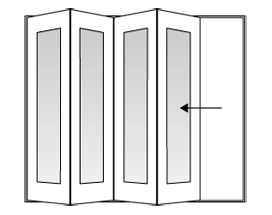
Here, you come face to face with a long stretch of rolling prairie visible through a 9 1/2’ tall by 20’ wide Folding Outswing Door, which takes up the entire north wall of the space and is complemented by a bank of windows above. “The vista is the most important part of the living room,” Johnson said.
On the opposite dining room wall is another expanse of glass letting in southern light through a wall of E-Series Hinged Patio Doors and floor-to-ceiling E-Series Picture Windows. Also on this wall is a bank of windows that’s cleverly disguised as a dormer window on the exterior.
These voids on both the north and south walls ensure an abundance of natural light at all times of day. The dark window frames “dissolve away,” letting the landscape dominate. The outward orientation of the interior establishes a decidedly modern aesthetic that makes the most of the stunning site.
“We wanted to amplify the reasons why they built here,” Johnson said. The home is in the White Oaks Savanna development, which is set on acres of restored prairie and wetland outside Minnesota’s Twin Cities metro area.
Space for gathering and retreating
The home is about 7,000 square feet with an H-shaped layout. The open-concept space is at the center with owner and guest suites concentrated in the east and west wings. This allows for comfortably sharing the home with extended family for long stretches, which is one important aspect of the program.
The second story is mostly devoted to these more private spaces and reached by a spectacular stair that’s lit by the two-story window unit that dominates the western gable. A “catwalk” on the second floor connects the two wings skirting the open-concept space and passing under the clerestory window.
Although the home is mostly modern on the interior with a more minimalist aesthetic established through clean lines and selective use of cool and calming colors, efforts were also made to soften and warm the home. This was achieved through the richness of natural light and materials like the Douglas fir cladding on the ceiling.
That balance helps create a tranquil mood, which is the reason the owners landed on “Elysian Fields” as their home’s name — a name that alludes to a Greek myth about finding eternal happiness, reflecting the feeling their new home conveys.


Up next
Projects
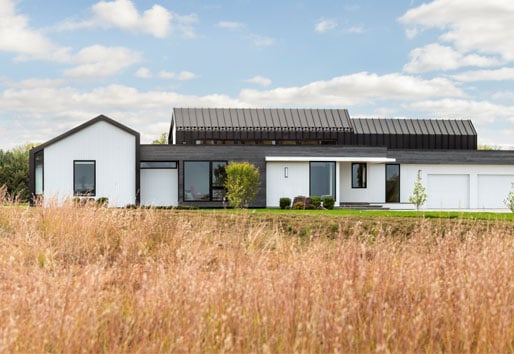
A contemporary prairie home that’s rooted in place
When you think of a house on the prairie, you might picture a farmhouse, but that’s not what this homeowner had in mind! He turned to Minneapolis-based Christopher Strom Architects for a contemporary design.
Unlimited possibilities
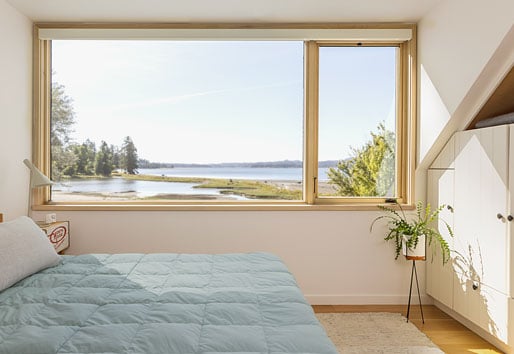
Explore our E-Series windows and doors
Our E-Series windows & patio doors, as part of the Architectural Collection, are made to your exact specifications for unmatched flexibility and design freedom.
Product
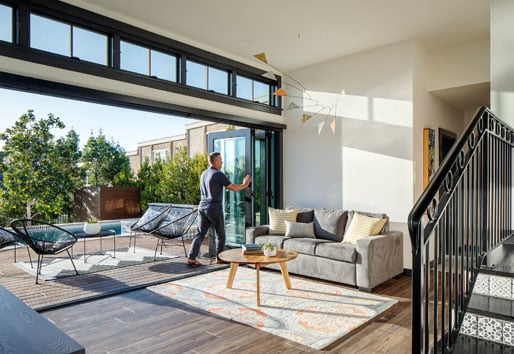
Folding Outswing Door
A different approach to removing the lines between indoors and out. When open, these moving glass walls fold up to beautifully frame your view. When closed, they create a stately wall of light.
